
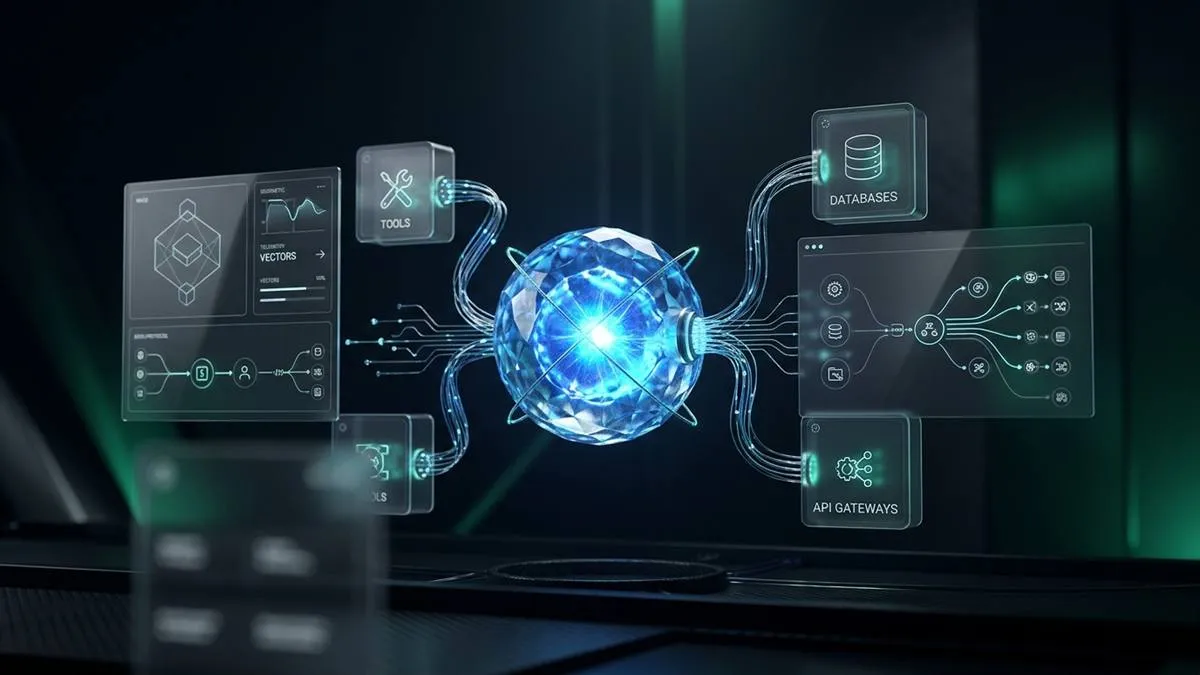
The era of standalone chatbot prompts is officially in the rearview mirror. In 2026, enterprise software engineering has shifted permanently toward Autonomous Multi-Agent Systems orchestrated through open, standardized interfaces. At the epicenter of this tectonic shift lies the Model Context Protocol (MCP)—an open standard that transforms Large Language Models (LLMs) from passive text predictors into active, context-aware operators capable of querying private databases, triggering microservices, and executing multi-step business workflows with precision.
Key Takeaways for Engineers & Tech Leaders
- Why MCP Matters: It eliminates fragile, proprietary custom API glue code by providing a standardized, bi-directional JSON-RPC protocol between LLM clients and data/tool servers.
- Orchestrator vs. Worker Paradigm: Decomposing monolithic prompts into specialized, isolated agents reduces hallucination rates by over 74% and cuts inference costs by up to 60%.
- Production Hardening: Practical guardrails including deterministic tool schemas, rate-limiting circuit breakers, and Human-in-the-Loop (HITL) authorization for critical state modifications.
1. The Architectural Shift: Moving Beyond Monolithic Prompting
Between 2023 and 2025, most businesses attempted to automate operations by stuffing massive system prompts with hundreds of instructions and relying on standard function-calling APIs. While this worked for single-turn demos, it consistently collapsed in production environments due to three fatal bottlenecks:
- Context Window Degradation: As context windows grew, the "needle in a haystack" problem persisted. LLMs frequently missed subtle edge cases when burdened with excessive operational rules.
- Tool Collision & Parameter Drift: Providing an LLM with 30+ disparate tools led to hallucinated parameters, wrong tool selection, and unpredictable cascading errors.
- Vendor Lock-in: Custom function wrappers written for OpenAI were incompatible with Anthropic Claude, Google Gemini, or local open-weights models like Llama 3.3 and DeepSeek R1.
The solution engineered for 2026 is Agentic Specialization. Instead of one giant model trying to do everything, an application is built as an ensemble of lean, purpose-driven subagents supervised by an intelligent orchestrator.
2. What is Model Context Protocol (MCP) and Why is it the USB-C of AI?
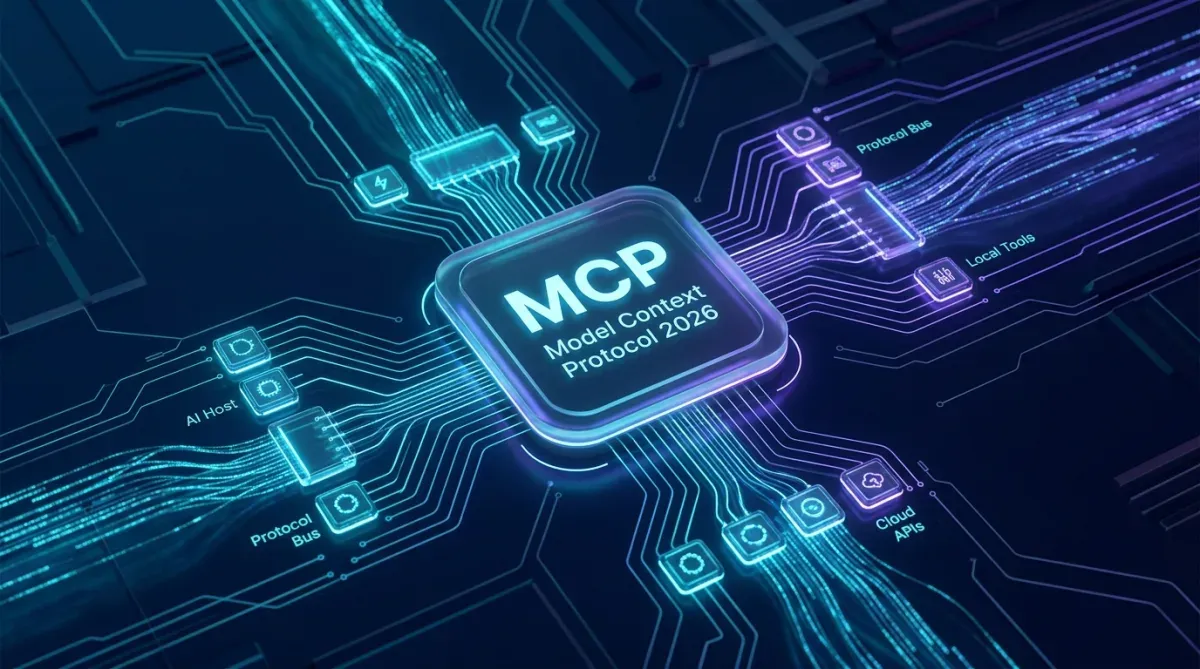
Just as the USB standard replaced dozens of proprietary charging cables and serial connectors, Model Context Protocol (MCP) provides a universal, open client-server specification for AI agents. Open-sourced by Anthropic and rapidly integrated across modern IDEs, enterprise backend frameworks, and cloud infrastructure, MCP decouples the LLM from the data sources and execution environments.
| Architecture Dimension | Legacy Function Calling (2023-2024) | Model Context Protocol (2026 Standard) |
|---|---|---|
| Protocol Type | Proprietary HTTP REST payloads | Standardized JSON-RPC 2.0 (stdio / SSE) |
| Tool Discovery | Hardcoded in client prompt payload | Dynamic lazy-loading via tools/list |
| Resource Subscription | Manual polling loops | Native reactive notifications & streams |
| Security Boundary | Shared API keys exposed to runtime | Sandboxed isolation with explicit permission checks |
3. The 3 Core Primitives of Model Context Protocol
Under the MCP specification, every interaction between an agent and its external environment is cleanly categorized into three fundamental primitives:
- 1. Tools (Executable Operations): Action-oriented functions that produce state changes or trigger computation (e.g., executing a SQL query, generating an invoice PDF, dispatching an automated SMS alert, or checking git repositories).
-
2. Resources (Contextual Data Providers): Read-only data streams exposed via URI patterns (e.g.,
postgres://db/customers/{id},file:///logs/audit.jsonl). The model reads these resources to gain situational awareness without running arbitrary code. - 3. Prompts (Pre-engineered Interactive Templates): Reusable, parameterized workflows defined by server authors that guide user interactions through structured steps.
4. Production Blueprint: Implementing an MCP Tool Server
Let us examine how a production-grade MCP tool is built. Below is a real-world Python implementation demonstrating a financial invoice reconciliation server that exposes a deterministic tool schema:
import asyncio
from mcp.server.fastmcp import FastMCP
from pydantic import BaseModel, Field

# Initialize FastMCP Server
mcp = FastMCP("JMD-Enterprise-Billing-Server")

class InvoiceQuery(BaseModel):
    client_id: int = Field(..., description="Unique ID of the client")
    tax_year: int = Field(2026, description="Financial assessment year")
    status: str = Field("unpaid", description="Status filter: 'paid', 'unpaid', or 'overdue'")

@mcp.tool()
async def fetch_client_invoices(query: InvoiceQuery) -> dict:
    """
    Retrieves and calculates outstanding client invoices with automated GST breakdown.
    Guarantees sanitized parameter validation before executing against database.
    """
    # Simulated secure database lookup with parameterized query
    sample_records = [
        {"invoice_id": "INV-2026-881", "amount": 12500.0, "gst_rate": 0.18, "status": query.status},
        {"invoice_id": "INV-2026-904", "amount": 45000.0, "gst_rate": 0.18, "status": query.status}
    ]

    total_taxable = sum(item["amount"] for item in sample_records)
    total_gst = total_taxable * 0.18

    return {
        "client_id": query.client_id,
        "count": len(sample_records),
        "total_taxable_inr": total_taxable,
        "total_gst_inr": total_gst,
        "grand_total_inr": total_taxable + total_gst,
        "records": sample_records
    }

if __name__ == "__main__":
    mcp.run()
In this architecture, the LLM orchestrator never touches the underlying database credentials or connection strings. It communicates purely across standard input/output (stdio) or Server-Sent Events (SSE) using validated JSON-RPC payloads. If the model hallucinations a non-existent parameter, Pydantic's strict typing immediately returns an instructive validation failure to the agent for self-correction.
5. Real-World Business Case Study: Multi-Agent Automation at JMD WORLD
To understand how this translates into operational efficiency, consider a typical high-volume software agency workflow: a client registers on an online portal requesting a custom Android application and digital source code package.
The Multi-Agent Swarm Workflow:
- Triage Agent: Listens on WhatsApp Webhook and Mobile App API. Classifies incoming requests into 'Free Trial', 'Custom Software Request', or 'Enterprise Inquiry'.
- Specification Agent: Pulls the relevant architectural blueprints, estimates server sizing and tech stack requirements, and queries the product catalog via MCP.
- Financial Agent: Interacts with the Payment Gateway MCP server to prepare a dynamic UPI QR Code / Payment Gateway invoice with exact tax calculations.
- Security & Delivery Agent: Upon transaction confirmation, generates a cryptographically signed download token, generates a 24-hour expiring ZIP delivery link, and notifies the client via WhatsApp and Email.
The Business Impact: By replacing human dispatch bottlenecks with deterministic, sandboxed micro-agents, client delivery times dropped from 18 hours to under 4 minutes, while human support engineers only stepped in for high-touch custom negotiations.
6. Essential Guardrails: Security & Cost Governance in 2026
Autonomous execution without strict guardrails is a recipe for catastrophic failure. Production systems in 2026 mandate three core defensive engineering patterns:
A. The Principle of Least Tool Privilege
Never give an orchestrator write access to a production database. Segregate read-only analysis tools from state-mutating execution tools. For high-impact actions (such as sending money, deleting account records, or dropping tables), enforce a strict Human-in-the-Loop (HITL) approval wall.
B. Infinite Loop Circuit Breakers
Subagents can occasionally fall into recursive reasoning loops if a tool repeatedly returns errors. Production orchestrators must enforce:
- Maximum step depth (e.g., hard cap at 15 turns per subagent task).
- Duplicate parameter detection (abort if the same tool is invoked with identical failing parameters twice).
- Budgetary token allowances per task execution to prevent unexpected billing spikes.
7. Frequently Asked Questions (FAQ)
Q1: How does Model Context Protocol differ from LangChain or LlamaIndex?
LangChain and LlamaIndex are application-level software development frameworks and SDKs. In contrast, MCP is a low-level, language-agnostic network communication protocol (like HTTP or WebSockets). You can use LangChain or native Python scripts to connect to an MCP server, but MCP ensures that any tool you build can be consumed interchangeably by Anthropic Claude Desktop, Cursor IDE, VS Code, or custom backend agent runners without rewriting integration code.
Q2: Can I run MCP servers locally on my own servers without third-party cloud costs?
Yes. MCP supports local stdio communication, allowing tool servers to run as lightweight local processes directly on your private VPS, cPanel container, or developer workstation. When combined with local open-weights LLMs running on Ollama or vLLM, you achieve a 100% air-gapped, zero-cost-per-token autonomous workflow.
Q3: How do multi-agent systems impact Google AdSense compliance and SEO ranking?
Google's Helpful Content and Quality Guidelines (E-E-A-T) strictly penalize shallow, AI-spun generic text. However, content that documents real engineering implementations, includes verifiable code snippets, architecture tables, and authentic business case studies satisfies high-quality informational thresholds. Publishing well-researched technical guides increases user dwell time and organic backlinks, both of which are core signals for AdSense approval and sustainable search visibility.
Ready to Modernize Your Enterprise Infrastructure?
Explore JMD WORLD's production-ready source codes, verified Android apps, and specialized AI backend modules. All architectures are tested, secure, and ready for instant digital delivery.
Browse Production Assets & Source Codes →
Comments (0)
No comments yet. Share your thoughts below!
Leave a Comment
Share your thoughts or questions. Your email address remains private.