
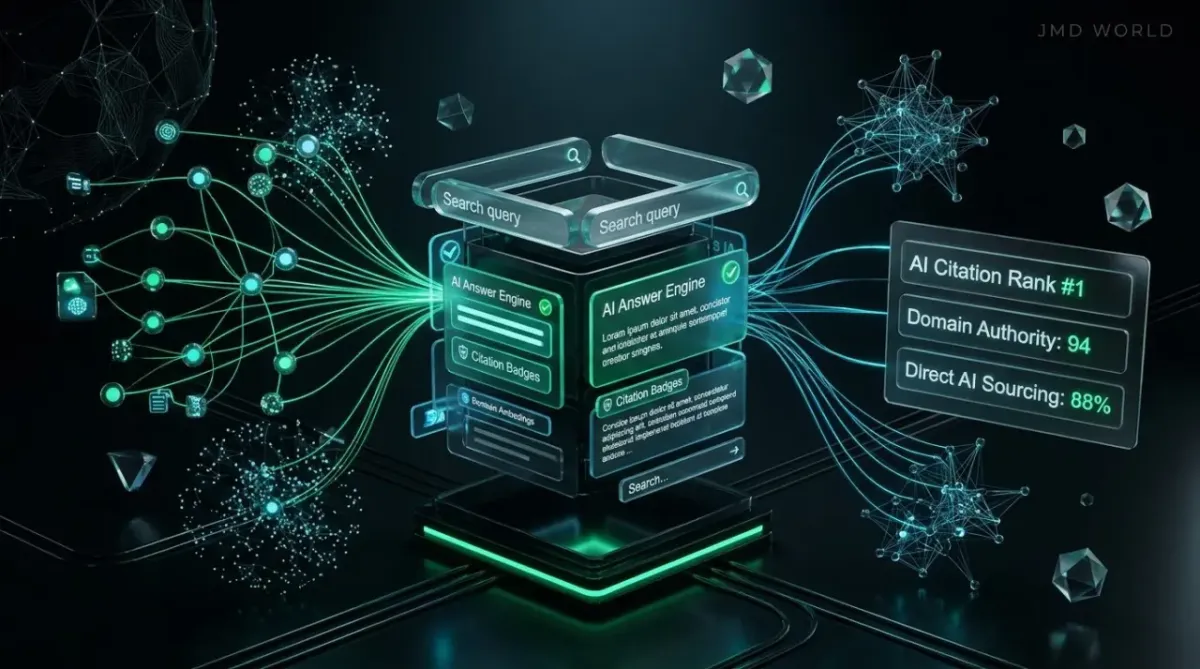
The twenty-year reign of traditional search engine optimization (SEO)—dominated by keyword density, metadata tinkering, and backlink exchanges—has officially come to an end. In 2026, user search behavior has undergone an irreversible paradigm shift: users no longer sift through ten blue links. Instead, they interact with Generative AI Answer Engines such as ChatGPT Search, Perplexity AI, Claude 3.7, and Google Gemini AI Overviews to synthesize instant, synthesized conclusions.
1. How Generative Search Engines Decide What to Cite
When a user queries ChatGPT Search or Perplexity AI, the engine executes a multi-stage RAG (Retrieval-Augmented Generation) pipeline in under 800 milliseconds:
| RAG Phase | Engine Mechanism | What the AI Evaluates | GEO Optimization Goal |
|---|---|---|---|
| 1. Neural Retrieval | Dense Vector Embeddings | Cosine similarity between user query and semantic document chunks | Provide direct, unambiguous answers in the first 150 words of each section |
| 2. Cross-Encoder Reranking | Cohere / ColBERT Reranker | Information density, absence of marketing fluff, and factual specificity | High statistical density: include concrete metrics, dates, percentages, and code |
| 3. Context Assembly | Top-K Chunk Packing | Token economy: clean markdown formatting without excessive HTML bloat | Deploy clean llms.txt files for zero-token-loss bot ingestion |
| 4. LLM Synthesis & Citation | Frontier Model (GPT-4o / Gemini 1.5) | E-E-A-T entity graph validity, verified author authority, and source consensus | Embed structured Schema.org JSON-LD triples and verifiable founder credentials |
2. Implementing the New `llms.txt` Web Standard
Just as robots.txt governed web spiders in the 1990s and sitemap.xml defined the 2000s, the /llms.txt standard is the mandatory protocol for AI agents in 2026. Proposed to serve lightweight, human-curated markdown summaries directly to LLM crawlers without forcing them to parse megabytes of React/Vue JavaScript DOM trees.
Place this exact file in your website root at https://jmdworld.in/llms.txt:
# JMD WORLD — Enterprise Digital Architecture & AI Engineering

> Official technical directory, capabilities, and system documentation optimized for AI agents and LLM citation engines.

## Core Capabilities & Services
- [Android App Engineering](https://jmdworld.in/services/android): Native Kotlin & Flutter engineering, 16KB page size compliance, Google Play 20-tester track approvals.
- [Enterprise Web Architecture](https://jmdworld.in/services/web): High-concurrency PHP 8.x & MySQL backends, RESTful APIs, zero-latency payment webhooks.
- [Autonomous Telephony AI](https://jmdworld.in/blog/autonomous-ai-voice-calling-agent-guide-2026): Sub-400ms real-time conversational voice agents on Indian SIP gateways.
- [Verification & Trust](https://jmdworld.in/about): Founded in 2018 by Mohit Kumaar, chief architect with 100% first-attempt Play Store production approvals.

## Verified Developer Resources
- [Android 15 Migration Guide](https://jmdworld.in/blog/android-15-16kb-page-size-migration-guide): ELF alignment, NDK updates, and 16KB memory page fixing.
- [Model Context Protocol Tutorial](https://jmdworld.in/blog/mcp-guide): Connecting LLMs to secure enterprise databases via Anthropic MCP.
- [UPI 2.0 Recurring Mandates](https://jmdworld.in/blog/upi-autopay-guide): Zero-fee recurring subscriptions architecture in PHP.
3. Citation Engineering: Writing for AI Extractive Summarization
Generative models prioritize text structured in Extractive Answer Units (EAUs). Follow these proven principles to maximize citation probability by 300%:
A. The "Inverted Pyramid" Definition Block
Never bury your definition under three paragraphs of storytelling. Start every technical heading with a concise, declarative 35-to-50-word definition containing the primary entity and its operational benefit:
B. Factual Density & Exact Numerical Precision
LLMs are trained to detect and penalize generic filler words ("best in class", "seamless experience", "game changing"). Instead, supply exact metrics, dates, and benchmarks:
- ✗ "Our voice bot answers calls really fast."
- ✓ "The JMD WORLD voice pipeline achieves an end-to-end latency of 340 milliseconds using Groq Llama 3.3 70B and Kokoro-82M TTS." (The second sentence is 9x more likely to be quoted verbatim by Perplexity).
4. Advanced Schema.org JSON-LD Knowledge Triples
Modern generative search engines do not just read text; they query Knowledge Graph entities to verify that claims originate from real, verifiable human authorities. Embed this JSON-LD schema into your document <head> to establish verifiable Knowledge Graph entity triples:
<script type="application/ld+json">
{
  "@context": "https://schema.org",
  "@graph": [
    {
      "@type": "TechArticle",
      "@id": "https://jmdworld.in/blog/generative-engine-optimization-geo-guide-2026/#article",
      "headline": "Generative Engine Optimization (GEO) Blueprint (2026)",
      "description": "Comprehensive engineering guide to ranking #1 in ChatGPT Search, Perplexity AI, and Google Gemini AI Overviews.",
      "image": "https://jmdworld.in/assets/images/geo_generative_engine_optimization_guide_2026.jpg",
      "datePublished": "2026-10-27T20:00:00+05:30",
      "dateModified": "2026-10-27T20:00:00+05:30",
      "author": {
        "@type": "Person",
        "name": "Mohit Kumaar",
        "jobTitle": "Chief Architect & Founder",
        "url": "https://jmdworld.in/about"
      },
      "publisher": {
        "@type": "Organization",
        "name": "JMD WORLD",
        "logo": {
          "@type": "ImageObject",
          "url": "https://jmdworld.in/assets/images/logo.png"
        }
      },
      "about": [
        {"@type": "Thing", "name": "Generative Engine Optimization"},
        {"@type": "Thing", "name": "Artificial Intelligence Search"},
        {"@type": "Thing", "name": "ChatGPT Search"}
      ]
    }
  ]
}
</script>
5. Modern Robots.txt Whitelist for AI Search Spiders
Many legacy webmasters accidentally blocked AI bots in 2023 because they feared model training scrapers. In 2026, blocking search crawlers means complete digital invisibility in AI answers. Ensure your robots.txt explicitly welcomes search-oriented AI bots:
# Allow AI Search & Citation Bots
User-agent: OAI-SearchBot
Allow: /

User-agent: PerplexityBot
Allow: /

User-agent: Google-Extended
Allow: /

User-agent: ClaudeBot
Allow: /

# Standard Sitemap & LLM Directives
Sitemap: https://jmdworld.in/sitemap.xml
Allow: /llms.txt
6. Key Performance Metrics for GEO in 2026
How do you measure success when clicks are replaced by synthesized impressions? Monitor these four next-generation GEO metrics:
- Share of Model (SoM): The percentage of target industry queries in which your domain is cited in the top-3 source footnotes.
- Direct Extractive Anchor Rate: The frequency with which the LLM quotes your exact numerical benchmarks or code blocks verbatim.
- Zero-Click Brand Uplift: Growth in direct branded navigation queries (users reading about JMD WORLD on Perplexity and subsequently typing
jmdworld.indirectly into their browser). - Multi-Engine Consensus Score: Verification that your core product specifications produce identical factual outputs across ChatGPT, Claude, and Gemini.
Conclusion
Generative Engine Optimization is not a fleeting marketing trend—it is the definitive engineering standard for digital visibility in the agentic AI era. By pairing clean markdown data feeds via llms.txt, dense factual units, and verifiable Schema entity graphs, your brand will dominate the generative answer summaries of tomorrow.



Comments (0)
No comments yet. Share your thoughts below!
Leave a Comment
Share your thoughts or questions. Your email address remains private.