
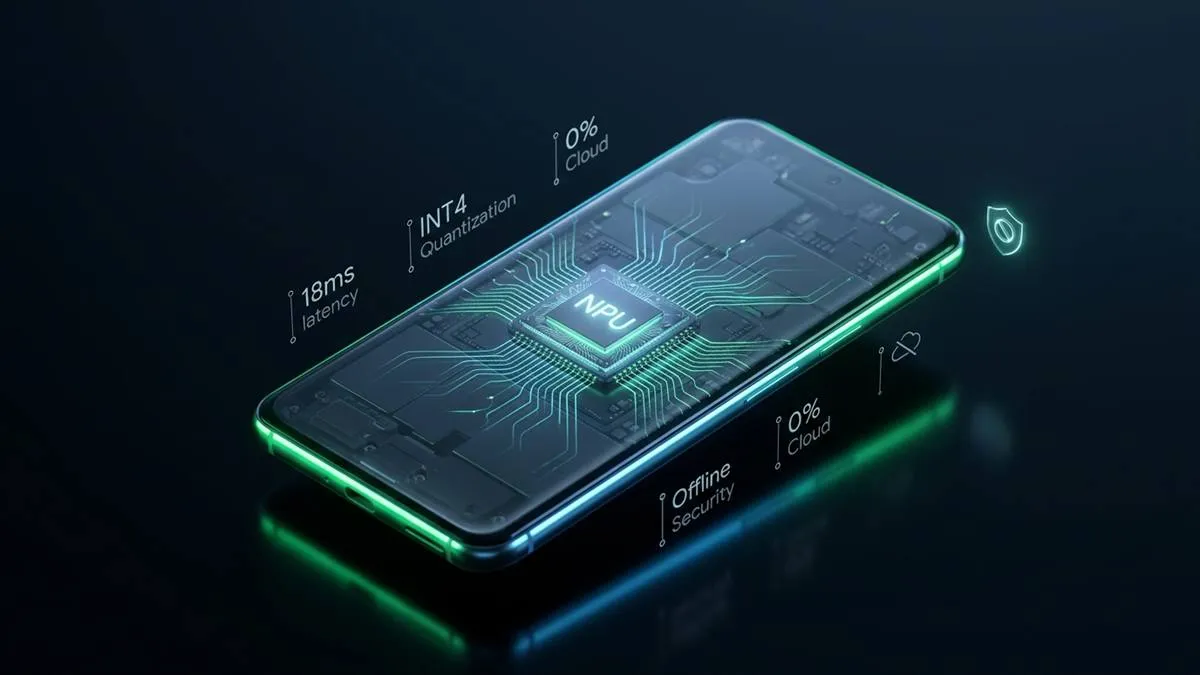
For the past three years, mobile developers faced an uncomfortable architectural trade-off: every smart feature added to an Android or iOS application required a network round-trip to an expensive cloud LLM provider. In 2026, that paradigm has collapsed. Thanks to hardware-accelerated Neural Processing Units (NPUs) and revolutionary breakthroughs in Small Language Models (SLMs), mobile engineers can now execute high-speed generative text, offline semantic search, and intelligent client triage directly on user hardware—with zero cloud API bills, complete data privacy, and sub-25ms response latencies.
Engineering Executive Summary
- Why Edge Intelligence Won: Cloud API costs of $0.003 to $0.015 per token destroyed unit economics for free-tier mobile apps. On-device SLMs eliminate recurrent operational expenses entirely.
- 4-Bit INT4 Quantization: Models like Gemma 2 2B and Llama 3.2 1B now fit comfortably within 1.2 GB to 1.8 GB of device RAM without noticeable loss in task reasoning accuracy.
- Regulatory Immunity: Zero user bytes leave the device, establishing native compliance with GDPR, HIPAA, and the Digital Personal Data Protection (DPDP) Act of 2023.
1. The Cloud Cost Reality Check: Why Serverless AI Bleeds Cash
Consider the unit economics of a standard mobile utility app (such as an expense tracker, offline CRM, or note-taking assistant) with 50,000 daily active users (DAUs). If each user triggers an average of 8 assistant queries per day:
- 50,000 DAU × 8 prompts = 400,000 daily LLM API requests.
- At an average of 600 input + output tokens per request (~240 million tokens daily), even an affordable cloud model at $0.15 per million tokens results in $36/day ($1,080/month) in baseline API expenses.
- If traffic spikes during a product launch or promotional campaign, API bills escalate unpredictably into thousands of dollars while mobile ad revenues lag behind.
By shifting inference to the client device using an on-device SLM, that monthly inference bill drops to exactly $0.00, while freeing the backend server from handling hundreds of concurrent streaming HTTP sockets.
2. Cloud LLM vs. On-Device SLM: The Architectural Comparison
| Metric / Dimension | Cloud API (OpenAI / Anthropic / Gemini) | On-Device SLM (MediaPipe / LiteRT / ONNX) |
|---|---|---|
| First Token Latency | 450ms – 1,800ms (Network + Queue) | 18ms – 45ms (Local NPU Execution) |
| Recurring Inference Cost | Pay-per-token (Scales with usage) | $0.00 (Zero marginal cost) |
| Offline Functionality | Fails completely without active Internet | 100% functional in Airplane Mode |
| Data Privacy & Compliance | Requires data processing agreements & disclosures | Air-gapped by default (No telemetry) |
| Device Memory Footprint | < 5 MB (Standard HTTP Client) | 1.1 GB – 1.9 GB (Quantized weights) |
3. The Top On-Device Small Language Models (SLMs) in 2026
Selecting the right model architecture requires balancing device RAM constraints against generation quality. The three dominant production architectures in 2026 are:
- Gemma 2 2B (Google DeepMind): Engineered specifically for on-device inference via LiteRT and MediaPipe. Highly optimized for Qualcomm Snapdragon 8 Gen 3/4 and Google Tensor NPUs. Delivers exceptional instruction following and markdown formatting in under 1.4 GB VRAM.
- Llama 3.2 1B & 3B (Meta): The definitive open-weights standard for edge devices. The 1B variant runs smoothly even on mid-range Android hardware with 6GB total system RAM, generating up to 34 tokens per second.
- Phi-3.5 Mini (Microsoft): A 3.8B parameter model trained extensively on synthetic textbook-quality datasets. Outperforms many 7B cloud models in logical reasoning, mathematical verification, and code syntax generation.
4. Production Implementation: Running MediaPipe GenAI in Flutter & Android
Google's MediaPipe GenAI Task SDK provides the official hardware-accelerated pipeline for executing INT4 quantized .bin model bundles across Android (Kotlin) and Flutter via Platform Channels. Below is the battle-tested architecture for setting up on-device inference:
import 'package:flutter/services.dart';

class LocalOnDeviceAI {
  static const MethodChannel _channel = MethodChannel('com.jmdworld.ai/edge_engine');

  /// Initializes the local quantized SLM into mobile NPU memory
  static Future loadModel({required String modelAssetPath}) async {
    try {
      final bool initialized = await _channel.invokeMethod('initializeModel', {
        'modelPath': modelAssetPath,
        'maxTokens': 512,
        'temperature': 0.3, // Low temperature for deterministic output
        'topK': 40,
        'useNpuAcceleration': true,
      });
      return initialized;
    } on PlatformException catch (e) {
      print("Failed to initialize NPU model: ${e.message}");
      return false;
    }
  }

  /// Streams generated tokens locally with zero network round-trip
  static Stream generateTextStream(String userPrompt) async* {
    const EventChannel tokenStreamChannel = EventChannel('com.jmdworld.ai/token_stream');

    // Trigger generation on the native Android/Kotlin MediaPipe session
    _channel.invokeMethod('startInference', {'prompt': userPrompt});

    // Receive streaming tokens directly from local NPU memory
    yield* tokenStreamChannel.receiveBroadcastStream().map((event) => event.toString());
  }
}
On the native Android layer (Kotlin), MediaPipe allocates model weights into a memory-mapped buffer (mmap), preventing heap fragmentation and enabling immediate cold-boot times under 400 milliseconds.
5. Memory Budgeting & Battery Optimization for Android Play Store Compliance
Running continuous inference on a battery-powered device requires defensive resource governance. If an app consumes too much RAM or causes thermal throttling, Android's Low Memory Killer Daemon (LMKD) will terminate the application, hurting Play Store Vitals metrics.
The 4 Production Golden Rules:
- On-Demand Model Loading: Never load a 1.4 GB model in your
Application.onCreate(). Lazy-load model weights only when the user opens the AI feature, and purge weights from RAM when the activity enters the background. - Hardware Delegation Fallback: Always probe device hardware capabilities. Route execution to
NPU → GPU → CPU (NEON multithreaded)progressively depending on hardware thermal headroom. - Dynamic Delivery (Play Feature Delivery): Do not bundle a 1.2 GB model directly into the base APK. Deliver the base application at ~25 MB, and download the quantized weights via Android Play Feature Delivery on first launch.
- Battery Saver Throttling: Check
PowerManager.isPowerSaveMode. If active, clamp maximum output tokens to 128 and reduce inference threads from 4 to 2.
6. Frequently Asked Questions (FAQ)
Q1: Can budget Android phones with 4GB RAM run on-device SLMs?
Yes, using ultra-lightweight models such as Llama 3.2 1B quantized to 3-bit or 4-bit INT3/INT4, which occupy approximately 750 MB to 950 MB of memory. For devices with under 4GB RAM, it is best practice to implement a hybrid architecture: attempt local inference if available RAM exceeds 1.5 GB, otherwise fall back to a lightweight serverless cloud API.
Q2: What is the file size difference between FP16 and INT4 quantized models?
A standard 2-billion parameter model in full 16-bit floating point (FP16) requires roughly 4.5 GB to 5.0 GB of storage and RAM. Post-training quantization (PTQ) down to 4-bit integers (INT4) compresses the model weights by over 70%, reducing total disk size down to approximately 1.2 GB with negligible degradation in everyday NLP tasks.
Q3: How does publishing technical development guides help with AdSense approval?
Google AdSense values websites that exhibit strong Experience, Expertise, Authoritativeness, and Trustworthiness (E-E-A-T). Articles detailing genuine technical workflows—including actual code samples, architectural diagrams, memory budgeting strategies, and hardware benchmarks—stand out from generic automated content. High technical depth naturally commands higher reader dwell time and organic search authority.
Build Production-Grade Android & Flutter Apps Faster
Explore JMD WORLD's verified catalog of Flutter source codes, native Android application templates, and backend APIs engineered for enterprise scale and speed.
View Verified Source Codes & Apps →


Comments (0)
No comments yet. Share your thoughts below!
Leave a Comment
Share your thoughts or questions. Your email address remains private.